Player Profiles
What a wicketkeeper's role demands that a scorecard never shows
The position is recorded almost entirely through dismissals, which leaves the majority of its actual workload invisible to anybody reading the match afterwards.
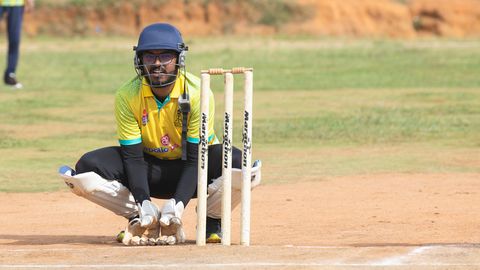
A role recorded by its exceptions
A wicketkeeper's contribution appears in the record only when a dismissal occurs, which happens on a tiny fraction of the deliveries they handle. Everything else, including the takes that prevented byes and the positioning that made a chance reachable, leaves no trace at all. The asymmetry means the visible record consists almost entirely of moments where something went right or dramatically wrong.
Ordinary competence, which is the bulk of the job and the hardest part to sustain, is precisely what the record cannot represent. Any profile of the position built from the scorecard is therefore describing the exceptions and calling them the role.
Standing up and standing back
Keeping to a fast bowler from a distance and keeping to a spinner from immediately behind the stumps are close to different disciplines. Standing back, the primary demands are reading deviation late, covering ground sideways and judging the height of a ball that has already been travelling for some time. Standing up, the ball arrives with far less time, the batter's body obscures the sight of it, and the keeper must remain still until the last possible moment.
Moving early when standing up is the classic error, because it commits the hands before the ball's final deviation has revealed itself. A keeper strong in one position is not automatically strong in the other, which is a distinction selection has to weigh explicitly.
The best view on the field
The keeper watches every delivery from directly behind the line, which gives them the clearest available read on how the surface and the ball are behaving. That vantage makes them a primary source of information for the captain, particularly about deviation, bounce and how a batter is moving. Communicating it usefully requires judgement about what matters, since a constant stream of observations is as useless as silence.
The role therefore carries an analytical component that has nothing to do with glovework and everything to do with reading the game continuously. Sides value keepers who can do this even when their pure catching is marginally behind an alternative.
Sustained concentration as a physical demand
The keeper is involved in every delivery of an innings, which is a pattern of engagement no other fielder experiences. Concentration under those conditions is not maintained continuously but cycled, switching on before each delivery and releasing immediately afterwards. Players who cannot cycle efficiently either fatigue early or lapse at intervals, and lapses in this position are unusually costly.
The squatting and rising involved adds a physical load that accumulates across a long innings and interacts with the concentration demand. This is why keeping is often described as the most tiring role on the field despite involving comparatively little running.
Profiling the position honestly
A useful profile of a keeper starts from the conditions they will face, since a surface with variable bounce asks for different qualities than a true one. It then separates the two keeping disciplines and assesses each against the bowling attack the side actually intends to select. Batting contribution complicates everything, because a side choosing a keeper for runs is explicitly accepting a lower standard behind the stumps.
That trade is legitimate and should be stated as a trade rather than disguised as a claim that the two candidates are equivalent. Stated openly, it becomes a question about which risk a team can better absorb, which is a far more tractable discussion.
- Most of the role is decision-making and positioning rather than catching
- Standing up and standing back are effectively two different jobs
- The keeper is the only fielder who sees every delivery from behind


